
A credit platform (also called a lending platform) is software that runs lending end to end: intake, underwriting, disbursement, servicing, collections, and supervisor-ready reporting. Manual loan processing means spreadsheets, email chains, and disconnected tools carry the loan book instead of one system of record. Fintech teams in Kenya hit the wall when volume, channels, and Central Bank of Kenya (CBK) reporting outgrow that patchwork.
When do loan processing problems signal a platform move? When reconciliation eats product time, approvals miss mobile expectations, and audit trails live in five exports. This guide maps the breakpoints—for fintechs, banks, MFIs, and integrators scoping a Kenya launch or a multi-brand rollout.
When do loan processing problems signal a platform move? When reconciliation eats product time, approvals miss mobile expectations, and audit trails live in five exports. This guide maps the breakpoints—for fintechs, banks, MFIs, and integrators scoping a Kenya launch or a multi-brand rollout.
Manual Loan Processing Challenges
When does manual loan processing stop scaling? It stops when every new product line adds a spreadsheet tab, and nobody trusts the portfolio total without a Friday reconciliation meeting.
At low volume, one officer and one channel still work. Growth breaks the model quietly—duplicate records, versioned policy files, and scorecards that never match collections.
At low volume, one officer and one channel still work. Growth breaks the model quietly—duplicate records, versioned policy files, and scorecards that never match collections.
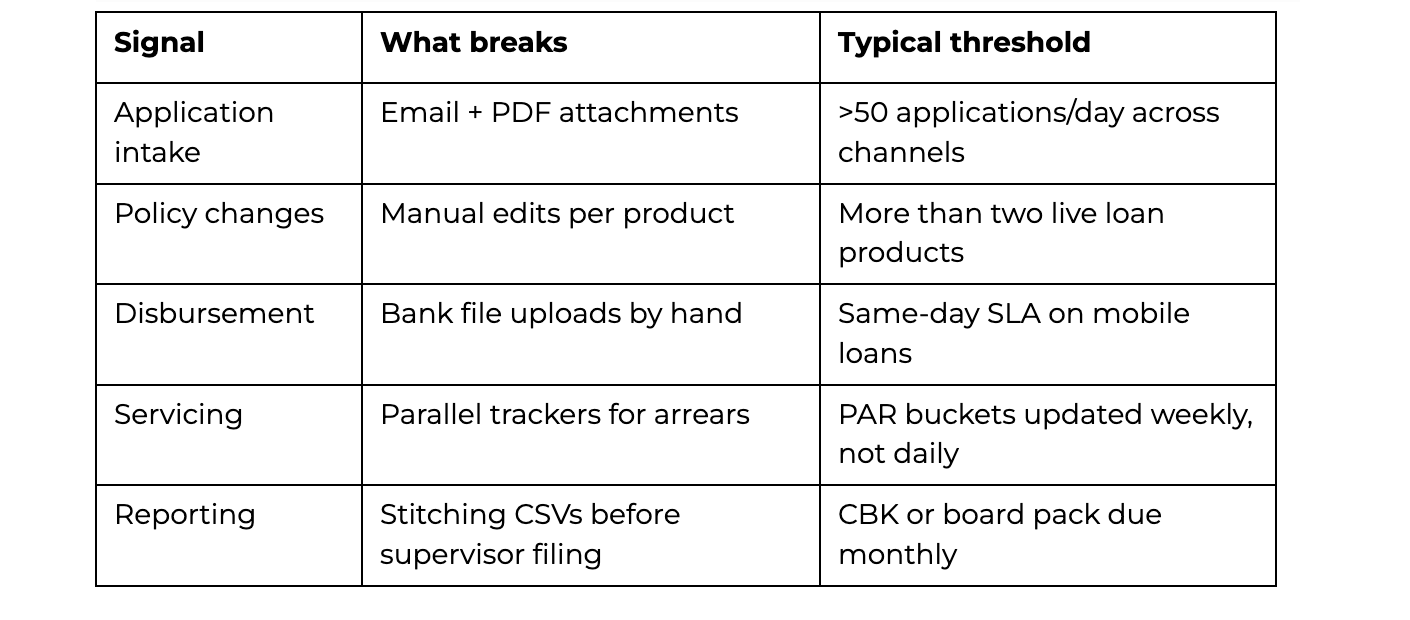
Shadow systems are the tell. Official LOS or core module exists; real decisions happen in Excel. Auditors ask for consent logs; ops sends screenshots. That is architecture debt, not training debt.
Consider a typical month-end close: USSD data sits in one export, web applications in another, and operational notes remain in Slack. Finance posts one total; risk sees another. Manual loan processing has no single borrower ID. A credit platform owns the lifecycle in one audit trail.
Consider a typical month-end close: USSD data sits in one export, web applications in another, and operational notes remain in Slack. Finance posts one total; risk sees another. Manual loan processing has no single borrower ID. A credit platform owns the lifecycle in one audit trail.
Benefits of Credit Platforms
What problem does a credit platform solve in Kenya? It replaces fragmented handling with one pipeline for mobile channels, fast policy change, and loan-level data supervisors can test through APIs—not quarterly CSV assembly.
A credit platform centralizes the borrower record from first touch through closure. Product teams configure fees, scorecards, and dunning in days. Integrators reuse one stack across brands.
CodHob offers Crystamo by CodHob PTE. LTD. as full-stack white-label lending from intake through regulatory reporting—managed lending infrastructure without a multi-year custom build.
Digital-first lenders often partner with banks for settlement while the credit platform manages the lending lifecycle. Deposit-taking banks may post approved loans into core; the platform still answers how the loan lives and gets collected.
A credit platform centralizes the borrower record from first touch through closure. Product teams configure fees, scorecards, and dunning in days. Integrators reuse one stack across brands.
- Speed-to-market: reprice without a vendor queue for every rule tweak.
- Channel parity: USSD (Unstructured Supplementary Service Data), app, and agent flows share one contract logic.
- Collections in scope: recovery sits with origination, not in a side spreadsheet.
- Reporting readiness: exports align with Kenya digital credit provider supervisory expectations.
- White-label scale: multiple logos on one engineering base.
CodHob offers Crystamo by CodHob PTE. LTD. as full-stack white-label lending from intake through regulatory reporting—managed lending infrastructure without a multi-year custom build.
Digital-first lenders often partner with banks for settlement while the credit platform manages the lending lifecycle. Deposit-taking banks may post approved loans into core; the platform still answers how the loan lives and gets collected.
Underwriting Automation Needs
When do lenders need underwriting automation? When policy rules outnumber people who can apply them consistently, and every manual exception lacks a timestamp.
Underwriting automation encodes policy once, runs it at scale, and logs overrides. Manual underwriting fails when queues grow faster than headcount—especially where mobile applications arrive overnight.
Underwriting automation encodes policy once, runs it at scale, and logs overrides. Manual underwriting fails when queues grow faster than headcount—especially where mobile applications arrive overnight.
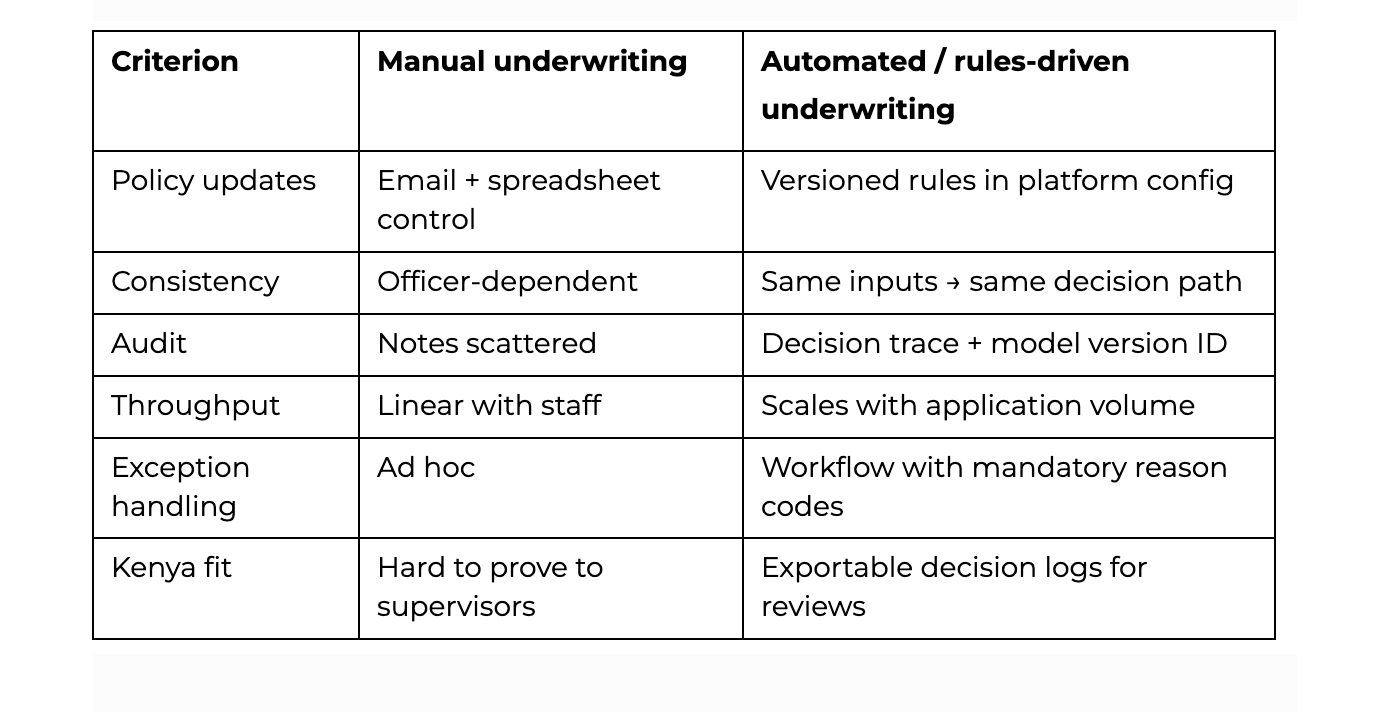
Triggers toward automation: pending decisions exceed one business day; pricing changes more than monthly; USSD and app must share one product definition; bureau feeds need real-time calls; CBK asks how a decline was decided.
Start with what hurts—repeat verification, not the final committee edge case. Automate the boring 80%; keep humans on thin files and fraud flags.
Start with what hurts—repeat verification, not the final committee edge case. Automate the boring 80%; keep humans on thin files and fraud flags.
Challenges with Fast Loan Volume Growth
What problem appears when loan volumes grow fast? Operations scale linearly while revenue scales faster—until reconciliation, collections, and reporting lag one cycle behind originations.
Disbursements outrun posting windows. Collections cases open faster than agents can call. Dashboards show originations up; PAR creeps up two weeks later.
How volume breaks manual stacks
A credit platform absorbs spikes because workflows and case management share one data model—horizontal scale beats another reconciliation hire.
In one Kenya-based lending review, originations doubled within ninety days while headcount increased by only 15%. Manual loan processing hid PAR until month three. After cutover, arrears tied to the same contract ID as origination.
Disbursements outrun posting windows. Collections cases open faster than agents can call. Dashboards show originations up; PAR creeps up two weeks later.
How volume breaks manual stacks
- Intake overload: duplicate applications flood shared inboxes.
- Disbursement limits: bank cutoffs miss same-day mobile promises.
- Servicing drift: billing desyncs when wallets and core disagree.
- Collections blind spots: dunning in one tool; receipts in another.
- Reporting crunch: month-end becomes rescue work, not routine close.
A credit platform absorbs spikes because workflows and case management share one data model—horizontal scale beats another reconciliation hire.
In one Kenya-based lending review, originations doubled within ninety days while headcount increased by only 15%. Manual loan processing hid PAR until month three. After cutover, arrears tied to the same contract ID as origination.
Issues with Fragmented Lending Data
What problem does fragmented lending data create? Nobody answers a borrower question in one screen—balance, payment, consent, and collection status live in four systems.
Scoring in one tool. Contracts in a document store. Repayments in a wallet ledger. Notes in email. Each piece works alone; together they fail audits and support.
Failure modes
One credit platform owns the loan journey and pushes events to core, bureau, and wallet partners through APIs with immutable timestamps.
Scoring in one tool. Contracts in a document store. Repayments in a wallet ledger. Notes in email. Each piece works alone; together they fail audits and support.
Failure modes
- Scoring vs. booking: approved limit in model A, booked amount in B.
- Channel vs. core: USSD terms differ from web agreement text.
- Collections vs. origination: recovery works stale balances when feeds lag 48 hours.
- KYC vs. lifecycle: verified identity never propagates to top-up or restructure.
- Reporting vs. operations: supervisor files built from exports, not live events.
One credit platform owns the loan journey and pushes events to core, bureau, and wallet partners through APIs with immutable timestamps.
Need for a Unified Credit Ecosystem
When does a lender need a unified credit ecosystem? When three or more vendors touch the lifecycle and no system owns application-to-closure—or when a second market would duplicate the same integration mess.
A unified credit ecosystem is one spine: origination, underwriting, disbursement, servicing, collections, notifications, and regulatory exports on shared identifiers. Point tools stay at the edges; the center is not a spreadsheet.
A unified credit ecosystem is one spine: origination, underwriting, disbursement, servicing, collections, notifications, and regulatory exports on shared identifiers. Point tools stay at the edges; the center is not a spreadsheet.
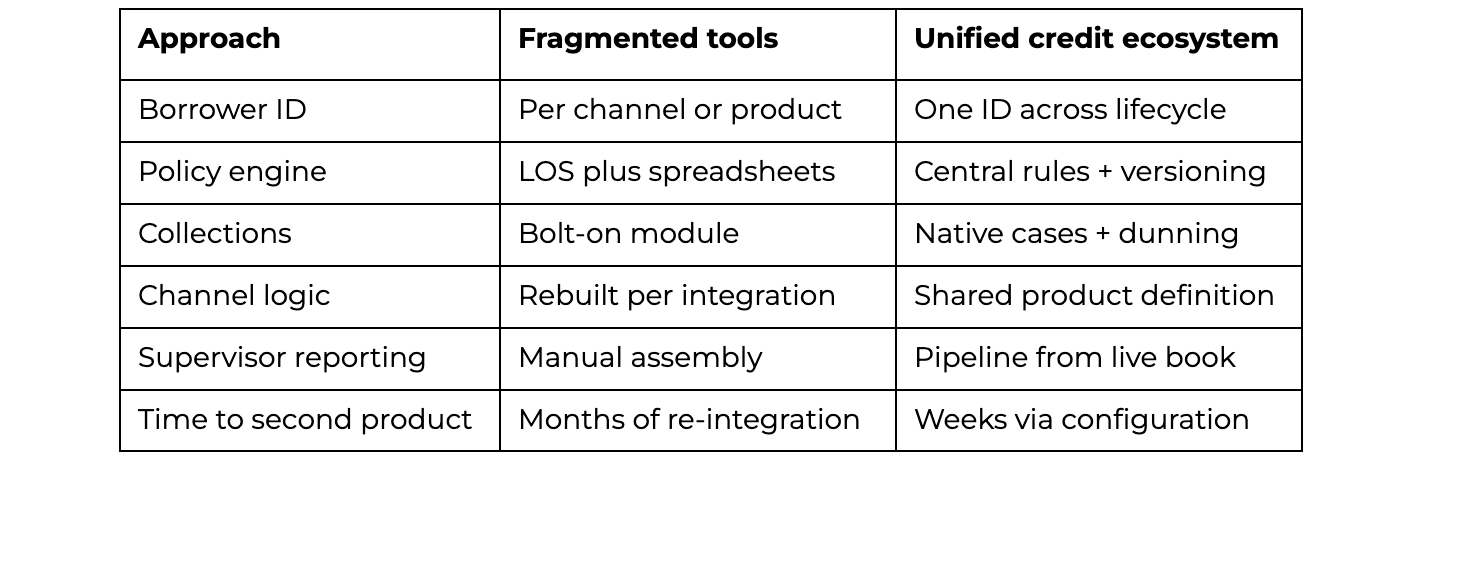
Licensed digital lenders, bank innovation units, regional MFIs, and fintech teams outgrowing intake-only monoliths need this first. Unification means one lending platform owns the loan book narrative—everything else plugs in.
Impact of Slow Loan Approvals in Kenya
What problem does slow loan approval cause in Kenya? Borrowers abandon mid-flow, acquisition cost rises, and supervisors still expect clean data—so you lose on growth and compliance when decisions wait in manual queues.
Applications arrive through USSD and mobile apps when underwriting teams are offline. A six-hour delay is a lost loan that never logged as declined. Competitors with automated decisioning capture intent while your officer reads email.
If web approves in minutes and USSD waits for batch upload, customers use the faster door—or leave.
Under the Central Bank of Kenya (Digital Credit Providers) Regulations, 2022 (2022 DCP Regulations), CBK has processed 800+ applications since March 2022. In its 30 December 2025 press release, CBK reported 195 licensed DCPs, 6.6 million loans, and KSh 109.8 billion disbursed (as of November 2025). Scale rewards continuous origination and reporting—not weekly decision batches.
Local pressures: API reporting gates for licensed digital credit providers; consent and pricing timestamps on one loan ID; partner-bank settlement after fast approval; dense competition on speed and UX.
Slow approval is policy in email, scoring outside booking, disbursement on manual bank files. A credit platform ties decision, contract, and disbursement in one workflow.
A Friday USSD promotion can lose momentum when approval queues remain unresolved until Monday, reducing campaign ROI.
Applications arrive through USSD and mobile apps when underwriting teams are offline. A six-hour delay is a lost loan that never logged as declined. Competitors with automated decisioning capture intent while your officer reads email.
If web approves in minutes and USSD waits for batch upload, customers use the faster door—or leave.
Under the Central Bank of Kenya (Digital Credit Providers) Regulations, 2022 (2022 DCP Regulations), CBK has processed 800+ applications since March 2022. In its 30 December 2025 press release, CBK reported 195 licensed DCPs, 6.6 million loans, and KSh 109.8 billion disbursed (as of November 2025). Scale rewards continuous origination and reporting—not weekly decision batches.
Local pressures: API reporting gates for licensed digital credit providers; consent and pricing timestamps on one loan ID; partner-bank settlement after fast approval; dense competition on speed and UX.
Slow approval is policy in email, scoring outside booking, disbursement on manual bank files. A credit platform ties decision, contract, and disbursement in one workflow.
A Friday USSD promotion can lose momentum when approval queues remain unresolved until Monday, reducing campaign ROI.
Transition from Custom-built to Credit Platforms
When do fintechs outgrow custom-built loan software? When engineering maintains integrations longer than it ships credit products—and every new channel reopens a six-month project.
Custom builds fit MVP: one product, one channel. Outgrowing a custom-built system happens when compliance and product teams require faster change cycles than sprint capacity allows, and a “temporary” spreadsheet becomes permanent.
Signs the stack is maxed
Custom builds fit MVP: one product, one channel. Outgrowing a custom-built system happens when compliance and product teams require faster change cycles than sprint capacity allows, and a “temporary” spreadsheet becomes permanent.
Signs the stack is maxed
- Roadmap is plumbing—wallets, bureau, SMS, reporting.
- No owned collections module after year two.
- Second product estimate rivals the first build.
- Only two engineers understand disbursement idempotency.
- Supervisor export is a script, not a product feature.
Migration path
- Freeze scope on the monolith.
- Move origination and underwriting to a credit platform with channel API parity.
- Migrate servicing and collections; avoid dual dunning.
- Wire reporting from platform events; retire CSV chains.
- Decommission custom modules after one clean supervisor cycle.
Crystamo suits teams wanting packaged lending infrastructure—Kenya go-live still needs local license, KYC partners, and CBK reporting hooks, not another intake rewrite.
Problems with Disconnected Scoring and Collection
What problem does disconnected scoring and collection create? Recovery fights yesterday’s model while originations use today’s scorecard—PAR rises because nobody links decline logic to thirty-day delinquency.
Underwriting optimizes approval; collections optimizes cash. Without shared data, you approve profiles you cannot collect from, and agents dial blind because wallet receipts never hit the case file.
Underwriting optimizes approval; collections optimizes cash. Without shared data, you approve profiles you cannot collect from, and agents dial blind because wallet receipts never hit the case file.
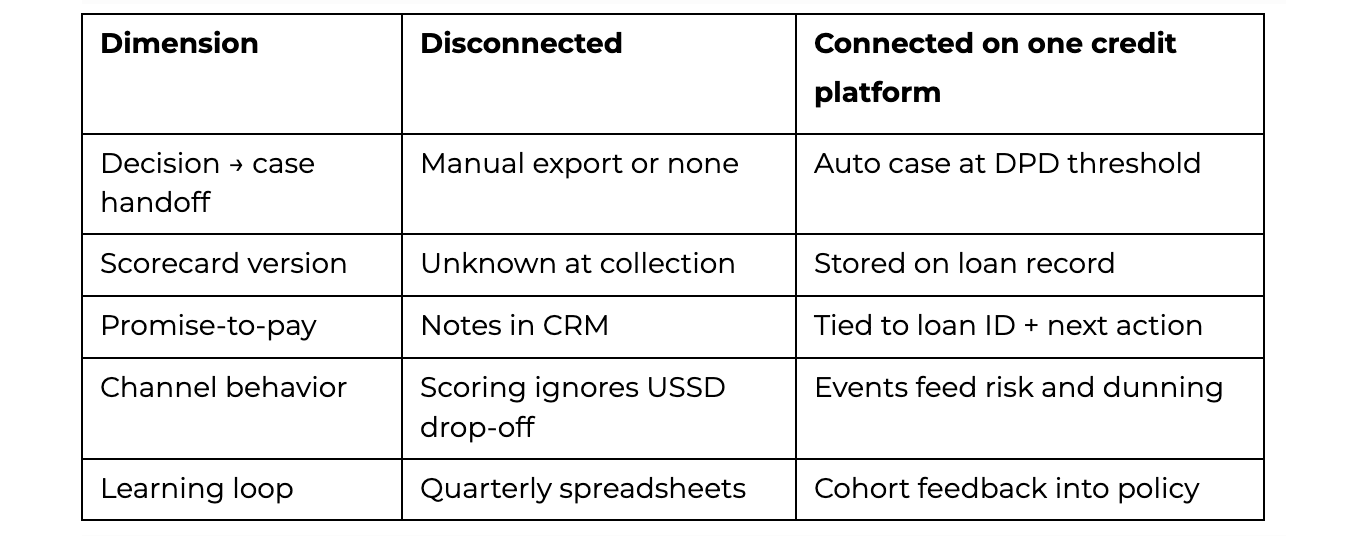
One credit platform stores the decision artifact on the loan and drives dunning from live balances—not a weekly arrears file.
A new scorecard can be deployed on Monday, but collections teams may continue working with outdated rules until the change is formally communicated. That week costs real money.
A new scorecard can be deployed on Monday, but collections teams may continue working with outdated rules until the change is formally communicated. That week costs real money.
FAQ
When does manual loan processing stop scaling?
When reconciliation and multi-channel intake eat more time than product work—usually before volume doubles.
When reconciliation and multi-channel intake eat more time than product work—usually before volume doubles.
What problem does a credit platform solve in Kenya?
It unifies mobile channels, policy change, collections, and supervisor-grade loan data so growth does not outrun compliance.
It unifies mobile channels, policy change, collections, and supervisor-grade loan data so growth does not outrun compliance.
When do lenders need underwriting automation?
When policy and volume exceed manual review—with decision trails supervisors can replay.
When policy and volume exceed manual review—with decision trails supervisors can replay.
What problem appears when loan volumes grow fast?
Posting, servicing, and collections lag originations; PAR rises before dashboards catch it.
Posting, servicing, and collections lag originations; PAR rises before dashboards catch it.
What problem does fragmented lending data create?
No single borrower view; audits rebuild the story from exports.
No single borrower view; audits rebuild the story from exports.
When does a lender need a unified credit ecosystem?
When three or more tools touch the lifecycle and no system owns application-to-closure on one ID.
When three or more tools touch the lifecycle and no system owns application-to-closure on one ID.
What problem does slow loan approval cause in Kenya?
Lost mobile conversions, higher CAC, and reporting risk when decisions sit outside the live loan record.
Lost mobile conversions, higher CAC, and reporting risk when decisions sit outside the live loan record.
When do fintechs outgrow custom-built loan software?
When integration work blocks new products and collections still run outside the codebase.
When integration work blocks new products and collections still run outside the codebase.
What problem does disconnected scoring and collection create?
Dunning without the score version that booked the loan; recovery disconnected from approval logic.
Dunning without the score version that booked the loan; recovery disconnected from approval logic.
How fast can a team move to a credit platform?
A typical Crystamo MVP is about three months, depending on scope and integrations—often faster than extending a custom monolith for a second product.
A typical Crystamo MVP is about three months, depending on scope and integrations—often faster than extending a custom monolith for a second product.